

Back in 2009 we started building our second product: awdit. awdit started off as a tool to help IT managers manage their computers more easily. It provided a neat SaaS dashboard and came with some particularly clever scanners that could examine Windows computers and report on their contents more accurately than contemporary tools could.
The idea was that it was sort of like the then-nascent Spiceworks — but a lot smarter, and without the cumbersome ad-supported interface. We started off looking at an Open Source product named SYDI, and contributed some code to that before moving to a stack that was entirely our own.
At the time, our other products were all targeted at consumers, and we found that selling to both enterprises and consumers was pretty tough. After all, the two groups are typically targeted by different approaches to marketing, and they buy in different ways. We had a number of companies and schools running the product in the UK, but in time we came to feel the juggling was too much to be able to support anyone well enough. (In the subsequent years we've learned how to do this, and we do it to this day.)
That gave rise to a question: was there another way we could run awdit, or use its technology?
I’d long been interested in the process of turning lots of unreliable data into factual data, and large amounts of the awdit code-base had been designed to do this. In particular, when scanning a set of machines for a network administrator, it’s important to report back what hardware and apps are installed, and what version or revision they are. This is an incredibly difficult problem to do fully on Windows, as application naming, localisation, and versioning are completely unnormalised. We’d built some clever logic that took a bunch of unstructured data and produced reliable facts on the other end.
This led us to the realisation that we could use awdit’s engine to solve a problem no-one else really could. At the time, other software or driver update tools that relied on crawling the web, manual data entry, and being “right enough that no-one will notice”™.
With our engine, we’d be able to categorically and canonically answer questions for users, including the following:
- Which apps on a machine were out of date, and how to update them
- Which drivers were out of data
- Which apps could open files of a particular type
I liked all of those questions, and we thought it would be cool to answer them. So we did it: we built a desktop app for consumers, pivoted awdit, and shipped the new app. And yes, it turned out we could answer those questions, and it was rather magical.
It also turned out that people dug what we were doing, and when we shipped the consumer app it ramped up to over a million monthly users in the first year. That was a wild ride, especially as another of our products had beaten 1,000,000 users a few months prior.
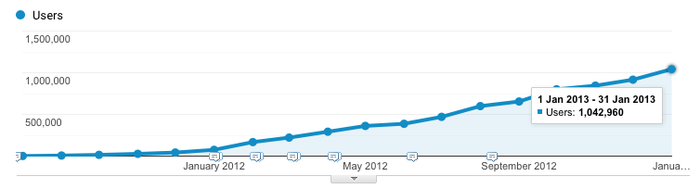
awdit’s first year of consumer traffic
awdit’s success led us to invest more in the platform. We shipped it in 6 languages, each with their own domain, licensed some supplementary data from a Canadian tech firm that we eventually bought out, and added functionality to optimise PCs: a registry cleaner, a tool to free up disk space, and functionality to make PCs boot quicker. We hired an amazing designer who helped us embrace Microsoft's fledgling Metro UI style.
We’d been working on another app at the time for recovering deleted files, and awdit's functionality fit well alongside it.
The huge growth in users led us to build out a number of tools and techniques which found later use in our APIs and other products. (A critical part of iPhone Backup Extractor is its ability to recover data from the latest version of each iOS app, and we gained the ability to rapidly detect those updates from awdit.)
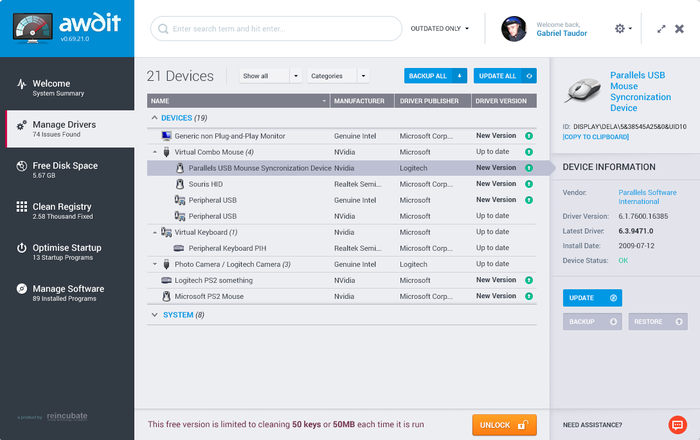
awdit, updating drivers as if by magic
It’s easy to forget how different things were back then. Software installers were fragmented, Windows Update and Driver Update Services were barely working, there was no Microsoft Store, and Windows was still ascendant.
Over the years, the factors that were in our favour changed, meaning that in many cases the problem we were solving was minimised. Microsoft’s continued investment in Windows Update did the platform a lot of good, but ironically it was Apple’s success with the App Store that had the biggest effect: users moved away from PCs, and PCs themselves took advantage of the new Microsoft Store. Sites hosting third-party software moved to ad-supported models, and followed the money into deceptive behaviour that damaged consumer trust. The web is a lot less safer than it used to be, and the big platforms are rightly stepping in to control software and hardware management better, and safeguard consumers.
The model we pioneered is still a sound one, and there's plenty of innovation still going on. Companies like AppAnnie and SensorTower built out similar systems, but focused on the new wave of mobile apps. More recently, it’s been flattering to see CoreCode launch MacUpdater, which sets out to do some of the things we did for PCs — but for Macs — and we wish them every success.
awdit's success isn't entirely helpful as things have changed. It likely has the world’s biggest database of hardware (over 20 million peripherals and components), drivers (8.6 million), and software version data (over 10 million analysed), and the cost of maintaining its infrastructure outweighs the value it provides.
As such, we’re going to be shuttering awdit in the coming weeks. Parts of it will live on internally in our other products, and we’re doing some planning for a follow-up awdit product which may see the light of day soon.
If you’re interested in licensing or acquiring parts of awdit’s technology or data, please reach out.
If you’ve been a user or a fan of awdit, thank you. It’s been fun, and stories from users on how we’ve helped have been a real source of energy whilst we built awdit. ❤️